 Synthyra
Paper
Synthyra and the University of Delaware
Atlas Host-Pathogen Interaction Report
A technical report applying Atlas to host-pathogen interaction prediction, with case studies on COVID-19 anosmia, drug repurposing for Andes hantavirus, and a scored recall test on Bundibugyo ebolavirus.
Logan Hallee, Jason P. Gleghorn
August 18, 2026
What is in the report
Benchmarks. Per-pair performance on the leakage-controlled Bernett split, proteome-scale intra-actome screens for human and 19 bacterial pathogens against a per-species supervised baseline, and a homology-controlled human-SARS-CoV-2 surface where prior methods sit at chance. The production checkpoint exceeds ProteomeLM's published intra-actome ROC AUC on H. sapiens by 0.123 absolute on the strict zero-shot subset.
Case study results
409of 433
human olfactory receptors
Engaged by a single uncharacterized SARS-CoV-2 protein, from a checkpoint with every SARS-CoV-2 sequence held out.
33s
to screen the approved drug catalog
2,638 small molecules and 626 biologics against the three Andes hantavirus proteins.
4of 4
approved antibodies placed correctly
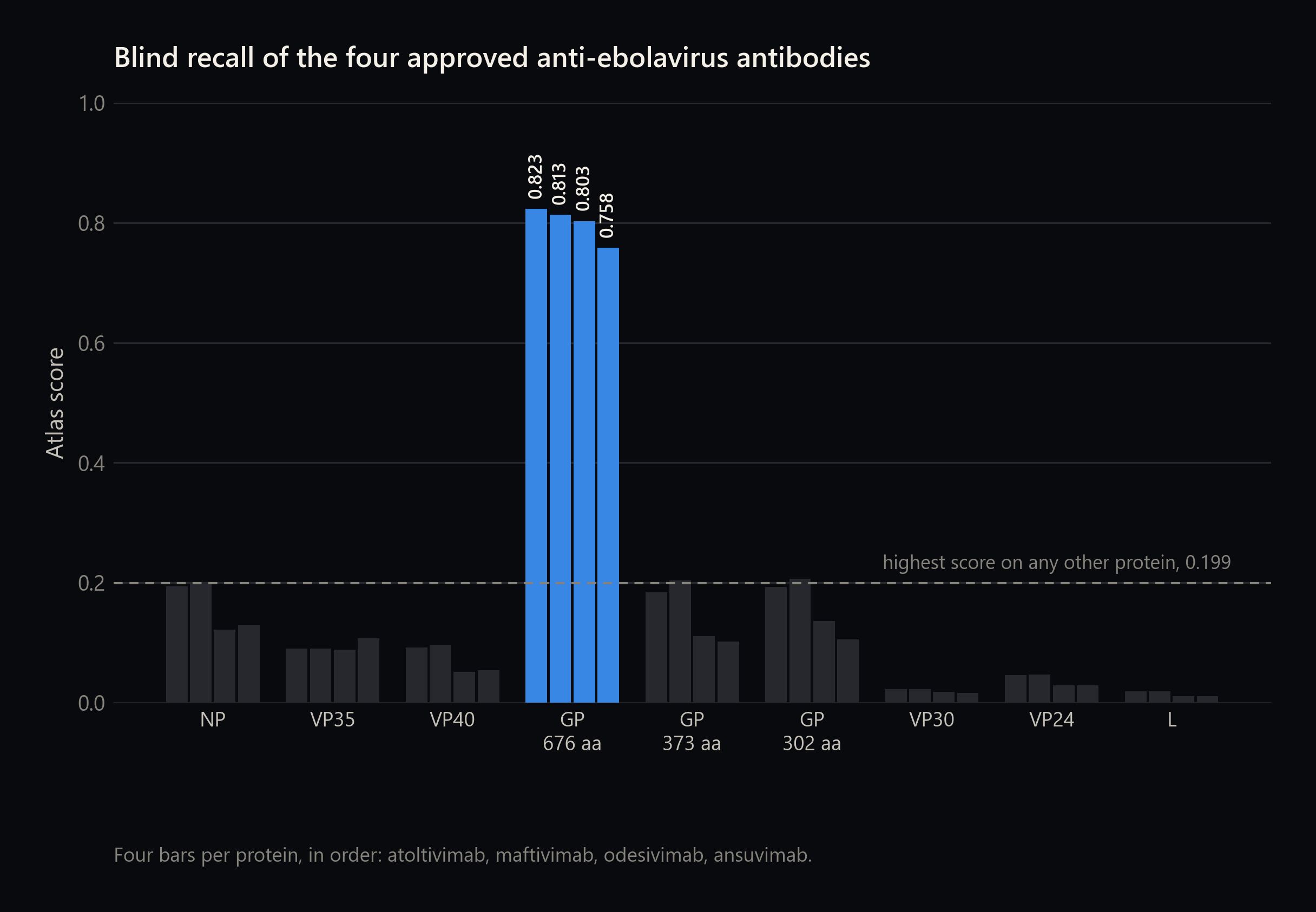
Assigned to the right antigen out of nine ebolavirus proteins, with a 3.7-fold margin and no score overlap.
Case Study I, COVID-19 anosmia. The 17-protein SARS-CoV-2 proteome screened against the human proteome, with a checkpoint that had all SARS-CoV-2 sequences held out under a strict homology cut. The screen recovers chemosensory and mitochondrial signal consistent with the published non-cell-autonomous mechanism, and names one previously uncharacterized viral protein predicted to engage 409 of the 433 human olfactory receptors. A nine-protein calibration table grades the same run against mechanisms the literature already settled: two clean recoveries, five weak, post-hoc, or contested, and two outright misses. Spike shows no olfactory-receptor enrichment, which rules out the trivial artifact in which every viral protein looks like an olfactory binder.
Case Study II, Andes hantavirus. Three viral proteins screened against 2,638 FDA-approved small molecules and 626 approved biologics in 33 seconds, followed by independent structural investigation of the top candidates. Two decades-old approved drugs outscore every antiviral with documented hantavirus activity on their respective targets: mupirocin, a topical antibiotic, at the nucleoprotein RNA-binding groove, and dornase alfa, already delivered by nebulizer to the organ this disease destroys, at the polymerase. The dornase alfa interface is the one novel result in the report reproduced by a second, architecturally distinct folding model.
Case Study III, Bundibugyo ebolavirus. A scored recall test. Four approved monoclonal antibodies bind ebolavirus glycoprotein and nothing else in the viral proteome, and the model was asked to place them across nine viral proteins with no target annotation. It assigned all four correctly, 3.7-fold above the highest score on any non-target, and separated the full-length glycoprotein from the two shorter secreted products of the same gene. Folding the same pairs inverts the answer, ranking three proteins these antibodies do not bind above the correct one.
Note
This checkpoint carries no filovirus homology holdout, so the antibodies and their antigen may both sit in its training corpus. The ebolavirus result measures retrieval rather than discovery; the held-out protocol used in Case Study I is the control that would change that.
Where it fails
The ebolavirus run misses the VP24-karyopherin interaction outright, placing all three NPI-1 karyopherins in the bottom 60% of the human proteome despite a published co-crystal structure of that complex, and it ranks NPC1, TIM-1, and DYNLL1 in the top 2 to 5% but below the operating threshold. None of the four antibodies is rank 1 on its own antigen; they sit at ranks 60, 88, 133, and 362 of the 626 biologics scored. On the hantavirus side, the same compound leads the biologic pool against a polymerase that has no cap-snatching endonuclease, so the sequence-level preference is for viral polymerases as a class and the domain-level claim rests on the folding step alone.
Sequence scoring and structure prediction fail on different inputs here, in both directions. That is the practical finding: agreement between them is informative, and neither is a sufficient filter by itself.
What this does not show
Nothing in this report establishes binding, efficacy, selectivity, or safety, and the nominated candidates are interesting because they are cheap to test rather than because the prediction is strong. Clinical translation requires independent experimental validation.
The full report follows below, and the platform this work is built on is described in the Atlas article.
Full report