 Synthyra
Systems-guided biological design
Optimize the outcome, not the interface.
Binder design works. A good binder and a good biological outcome are not the same thing. We put the outcome in the objective.
01 · Proteome
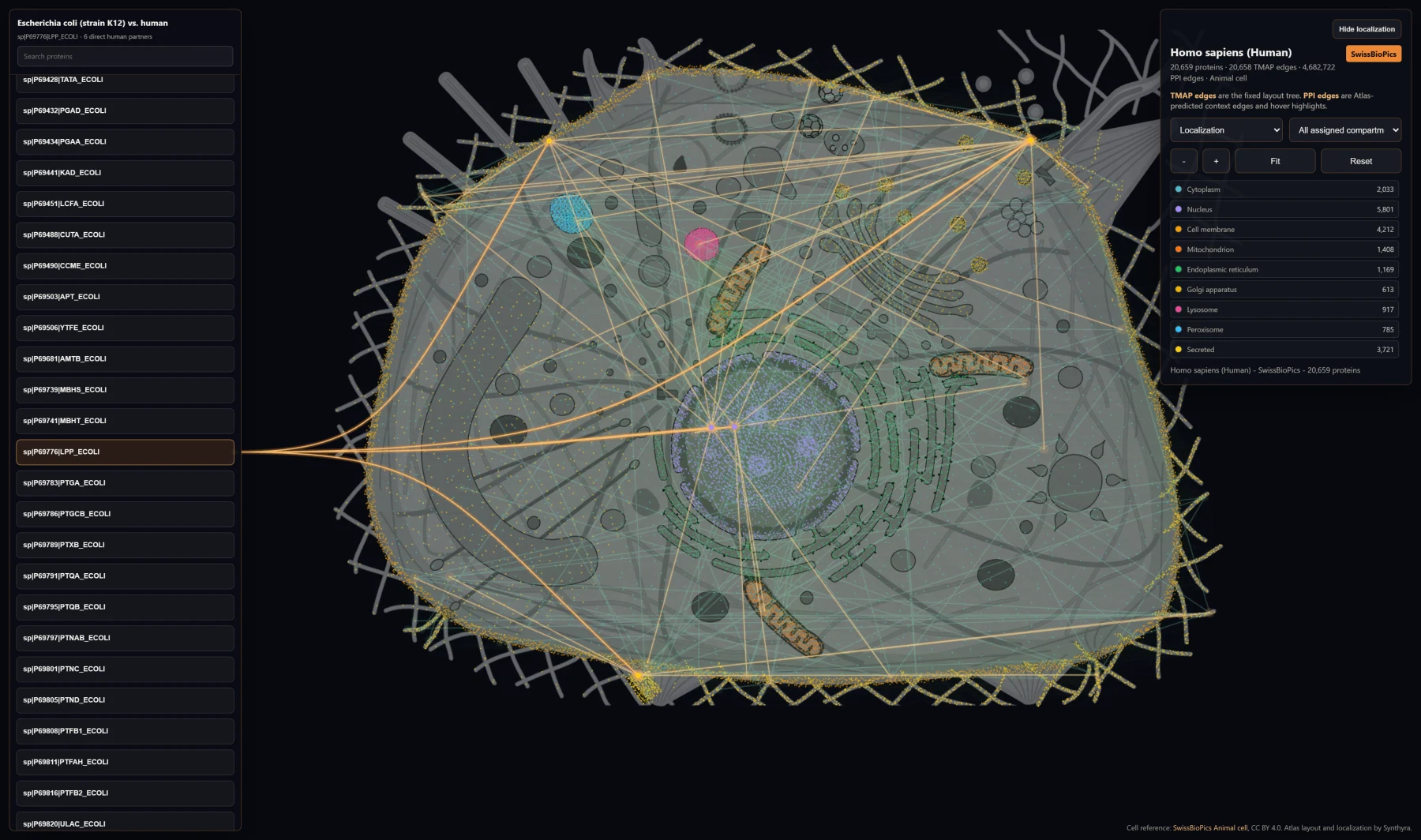
Signal spreads across a map of how human proteins interact.All natural human proteins
Info
Where every object on screen came from.
- Interaction map
- Synthyra Atlas-PPI predicted human interactome, 19,982 reviewed proteins.
- Cell diagram
- SwissBioPics animal cell, SIB Swiss Institute of Bioinformatics, CC BY 4.0. Redrawn as line art, embedded logos removed.
- Protein structure
- PDB 5B8C chain C, the PD-1 ectodomain. Public domain (CC0). Horita et al., Scientific Reports, 2016.
- Motion
- Anisotropic elastic-network normal modes from the C-alpha positions of 5B8C chain C.
- Metabolic model
- Human-GEM v2.0.0, SysBioChalmers, CC BY 4.0. Ten central-metabolism subsystems shown, currency metabolites hidden.
- Compounds
- Co-administered with pembrolizumab in registrational trials: pemetrexed (KEYNOTE-189), paclitaxel (KEYNOTE-407), gemcitabine (KEYNOTE-355), axitinib (KEYNOTE-426), fluorouracil (KEYNOTE-590), olaparib (KEYLYNK-010). Predicted targets from the Atlas protein-ligand screen.
- Ontology terms
- MHC protein binding (GO:0042287, 9 proteins), T cell receptor complex (GO:0042101, 53), adaptive immune response (GO:0002250, 420).
- Pathway and disease identifiers
- Reactome R-HSA-389948, PD-1 signaling. MONDO:0005105, melanoma, is the modeling context.
The premise
Binder design works. A good binder and a good biological outcome are not the same thing.
The objective
The disease response, not the interface. Efficacy up, toxicity down, across the whole system.
The context
Protein-protein interactions, protein-ligand relationships, and genome-scale metabolism, harmonized together.
The premise
A target is not a system.
The field has converged on one workflow. A target arrives, a molecule is designed against it, and the interface is scored on how well it binds. Underneath sits an assumption: that engaging the target produces the disease response you wanted.
That assumption is doing a lot of work. If you care about a disease response, why not treat that as the direct design goal?
Optimizing an interface tells you how the molecule behaves. It does not tell you what happens next.
Our thesis
Three terms, one decision.
Interface metrics are a proxy. We optimize the thing being decided: system context inside the design problem, and objective terms that stand for real consequences.
01
Efficacy
An abstract representation of the disease response, so a candidate is scored on the biological states it will produce, not the contact it makes.
02
Toxicity
Predicted toxcity based off of interaction propagation, honed by tissue and compartment specificity.
03
Interaction burden
Competing relationships, signaling induced by dosing, and drug-drug interactions.
Maximize the first. Minimize the other two. All accomplished with gradient descent.
Platform & services
The system context, available now.
The thesis needs a substrate. Protein-protein interactions, ligand relationships, functional annotation, and whole-system views are products you can use today: inspect a hypothesis, compare candidates, carry into experiments or further analysis.
Interactive system views
Trace a perturbation across biological context.
01
Discover
Protein and ligand relationships in proteome and cellular context.
Open
02
Demos
Interaction maps, model organisms, perturbations, and structure-aware views.
Explore
03
Models
The models and the evidence behind them.
Browse
04
Partner programs
Run a therapeutic, enzyme, or metabolic design program with us.
Contact
Protein relationships
The neighborhood a target sits in, not the target alone.
Ligand relationships
Predicted target breadth, which is where off-target burden shows up.
Function and annotation
What the surrounding proteins do, so an edge reads as biology.
System views
Molecular hypotheses in cellular and metabolic context.
Measured evidence
630 pM
An earlier design system produced a subnanomolar EGFR-binding variant.
Against the worldwide Adaptyv EGFR binder competition leaderboard, six of our designs land in the top seven, and the best of them takes first by a wide margin.
Read the EGFR case studyServices
Design programs for the biological outcome.
The same standard applied at three biological scales. In each, the question is what the system does afterward.
01
Therapeutics
Select for the disease response and against avoidable liability, not for binding alone.
02
Enzymes
Select for pathway outcome and host compatibility in the organism that has to run it.
03
Metabolic engineering
Compare interventions by what the network produces and what it costs.
Our vision
Design molecules with systems-level context.
The full argument, the objective terms, and the company trajectory that follows from them.
Read our vision