 Synthyra
September 18, 2025
BlogResearchSynteract-4: Interaction Prediction as Retrieval
Synteract-4 trains a frozen-encoder dual tower so protein embeddings can be compared directly for high-throughput PPI screening across proteomes.
- Protein Protein Interaction
- Synteract
- Atlas
By Logan Hallee
The central move in Synteract-4 is to stop treating protein-protein interaction prediction as only a pairwise classification problem.
Pairwise classifiers are natural for benchmarks: give the model two proteins, ask for a label. They are less natural for proteome-scale biology, where the real question may involve millions or hundreds of millions of candidate pairs.
Synteract-4 treats PPI prediction as representation learning. A frozen protein language model encodes sequences. A dual-tower model learns an interaction-aware embedding space. The scaled dot product between two protein embeddings becomes the score.
After embedding, an interactome screen is mostly a matrix operation.
Why That Matters
The practical bottleneck in PPI prediction is scale. If every pair requires an expensive joint forward pass, a full proteome quickly becomes awkward. A retrieval-style model changes the cost structure: embed each protein once, then compare many proteins quickly.
That framing is especially useful for Atlas, where the desired workflow is not one isolated prediction. A user may want a query neighborhood, an intra-actome map, a host-pathogen inter-actome screen, or a list of candidate partners for follow-up.
What The Manuscript Tests
The Synteract-4 draft reports several evaluation surfaces rather than relying on one benchmark.
On the Bernett gold-standard benchmark, Synteract-4-Bernett reaches MCC of 0.34, which the manuscript frames as the strongest reported result on that leakage-controlled split.
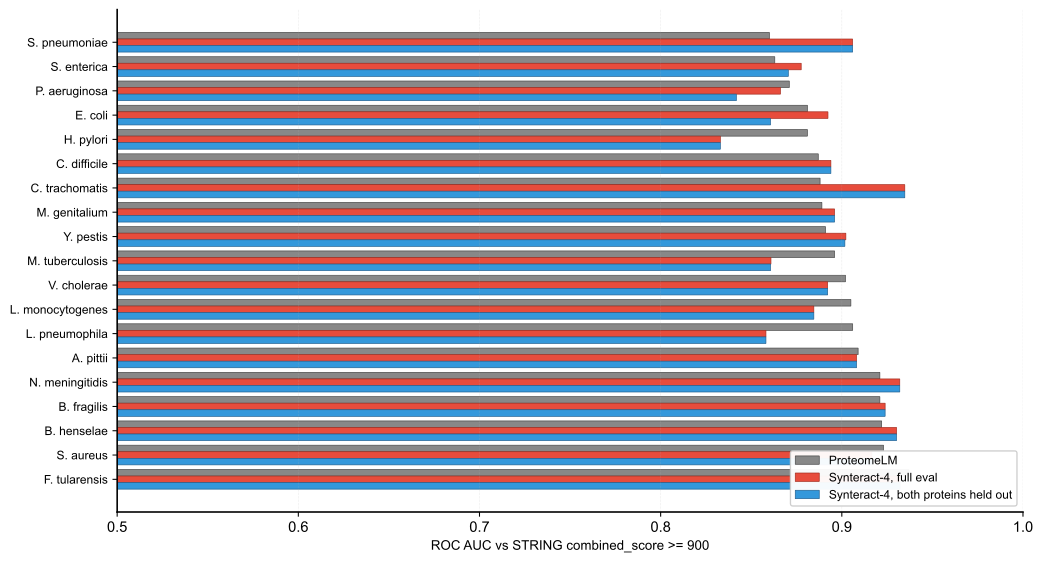
For proteome-scale intra-actome screens, the production-style Synteract-4 variant is compared against ProteomeLM across human and 19 bacterial pathogens. The draft reports human ROC AUC around 0.968, with 0.953 on a strict zero-shot subset, and mean ROC AUC around 0.899 across the pathogen panel.
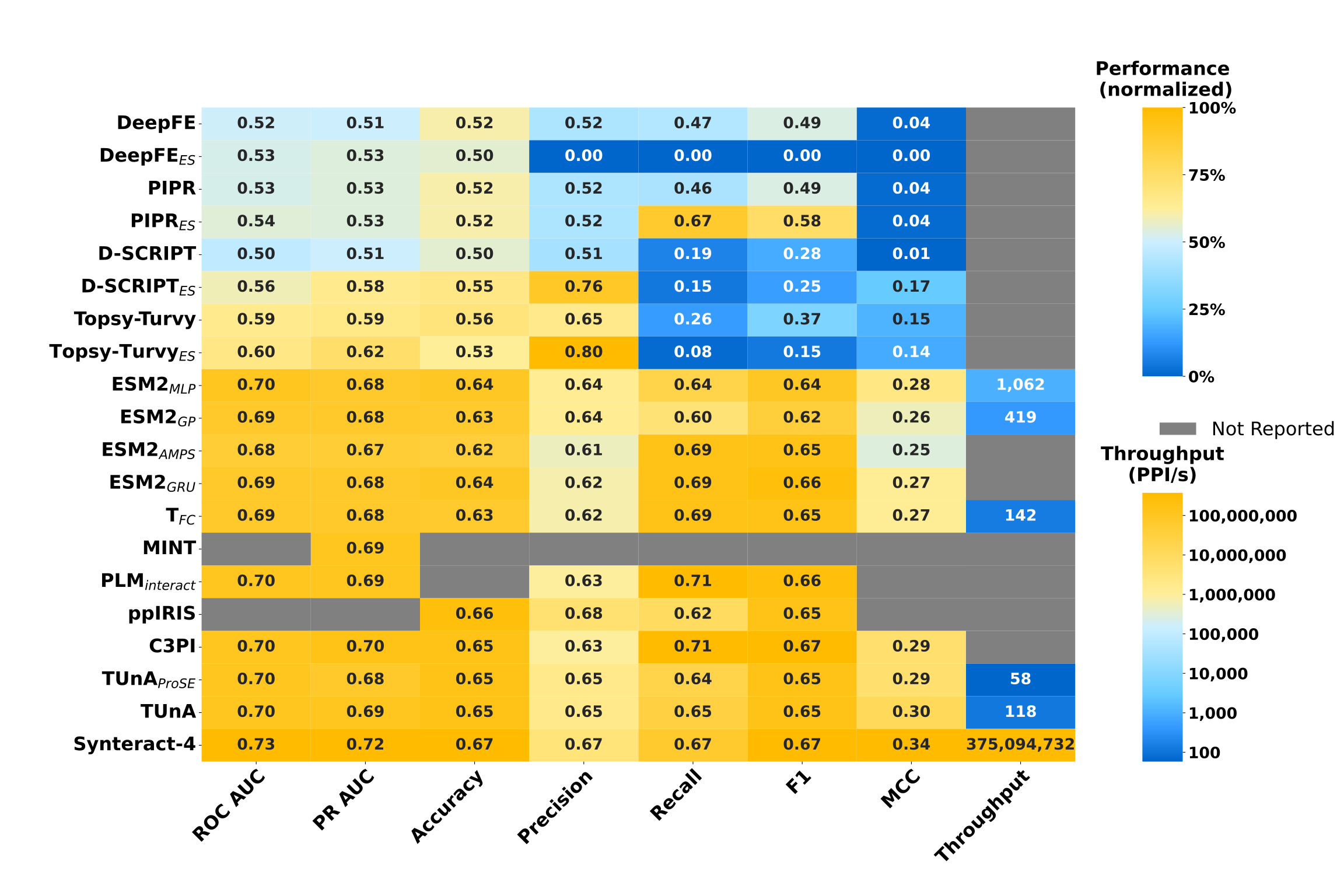
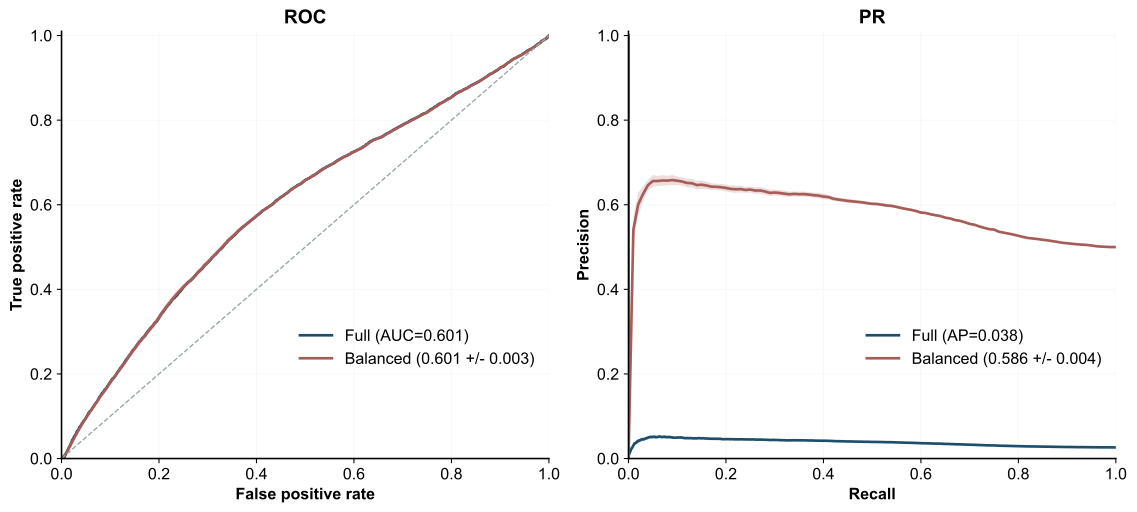
The paper also evaluates a homology-controlled human-SARS-CoV-2 setting. That matters because cross-species PPI is a hard surface where many human-trained PPI methods sit near random. Synteract-4-Sars remains modest, with ROC AUC around 0.601 in the draft, but the important point is not that this solves viral-host biology. It is that the model is above the random floor under a controlled interspecies test.
The HSP90 Anchor
The paper also uses HSP90 beta as a biological calibration point. HSP90 is a chaperone with a large literature and curated partner sets, which makes it useful for testing whether a model can recover known biology and candidate novel partners.
The draft reports cardiac HSP90 beta IP-MS from 24 human samples, including 29 partners absent from Picard, STRING, and BioGRID. At a literature-anchored positive-rate calibration, Synteract-4 recovers 15 of those 29 novel partners.
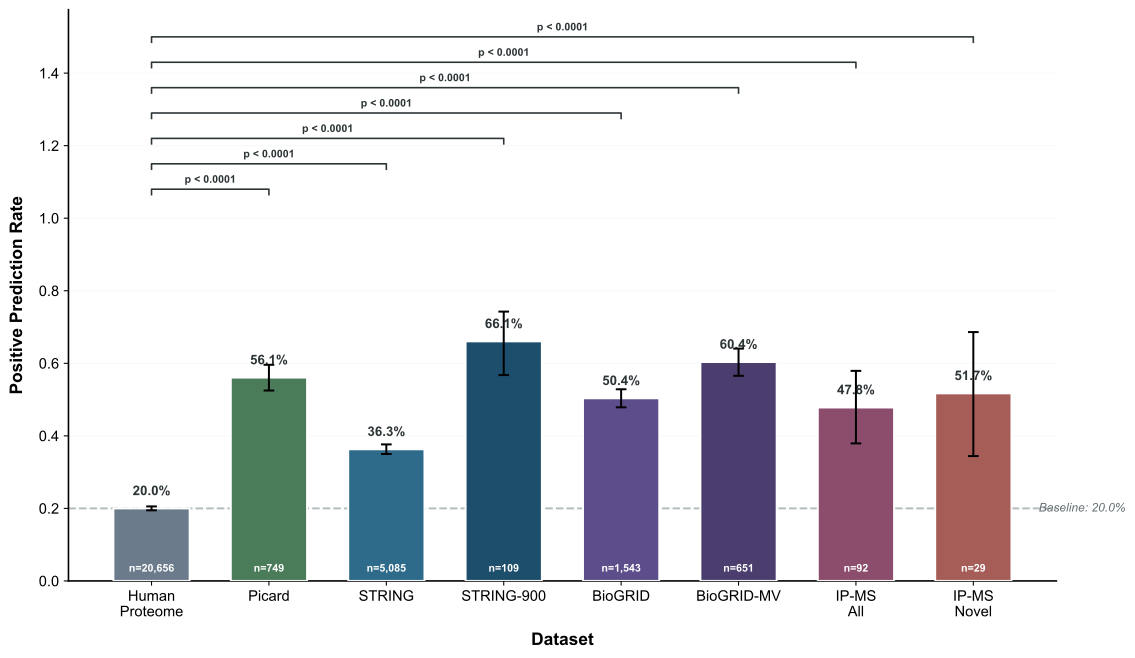
This does not mean the model proves a direct physical mechanism for every edge. It means the sequence-only retrieval model recovers a meaningful fraction of an orthogonal wet-lab partner list.
What Is Different From Earlier Synteract Work
The first Synteract paper asked whether pLMs could support sequence-only interaction prediction at all. Synteract-2 added affinity and binding-site directions.
Synteract-4 is more about the operating model. It asks whether the representation itself can carry the interaction score well enough to support fast, large screens.
That is also why the Accidental Taxonomists work matters here. Large multi-species PPI datasets can reward taxonomy shortcuts. Synteract-4 is built around cluster-aware training, leakage controls, and evaluation surfaces that make those shortcuts harder to hide.
Evidence Boundary
Synteract-4 scores are not binding measurements. They do not establish affinity, mechanism, cellular co-presence, or disease relevance by themselves.
Expression, localization, conformational state, cofactors, PTMs, tissue context, and assay conditions still decide whether a predicted pair is active in a real biological setting.
The narrower claim is still useful: sequence-only embeddings can make proteome-scale interaction search practical enough to guide experimental attention.
This blog post summarizes work in the following paper:
Sequence-Only Interactome-Scale Prediction of Protein-Protein Interactions
Logan Hallee, Richard Roberts, Sujoita Sen, Nikolaos Rafailidis, Tamar Peleg, Halley Echols, Chi Keung Lam, Jason P. Gleghorn
Manuscript draft, September 2025
Related Research
April 22, 2025
BlogSynteract2: The Next Stage in Protein Interaction Prediction
Synteract2 extends sequence-based interaction modeling toward affinity and binding-site prediction while keeping evaluation caveats explicit.
- Protein Protein Interaction
- Synteract
- Atlas
June 7, 2023
BlogSynteract: Predicting Protein Interactions from Sequence
Synteract showed that large protein language models could help predict protein-protein interactions from amino acid sequence alone.
- Protein Protein Interaction
- Synteract
- Atlas